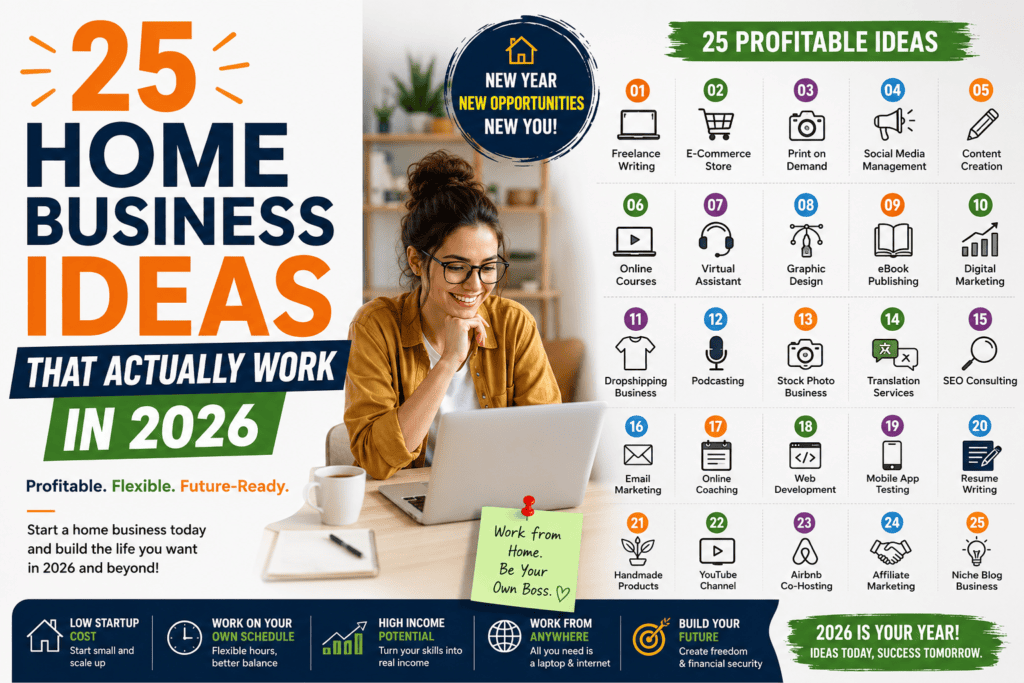
25 Home Business Ideas That Actually Work in 2026
Starting a business from home is one of the most accessible ways to earn extra income or replace a full-time job, especially now that most industries support remote work. But “home business ideas” is a broad category, and not every option fits every person’s skills, budget, or schedule.
This guide breaks down realistic home business ideas by category, what each one actually requires, and how to figure out which is the best fit for you.
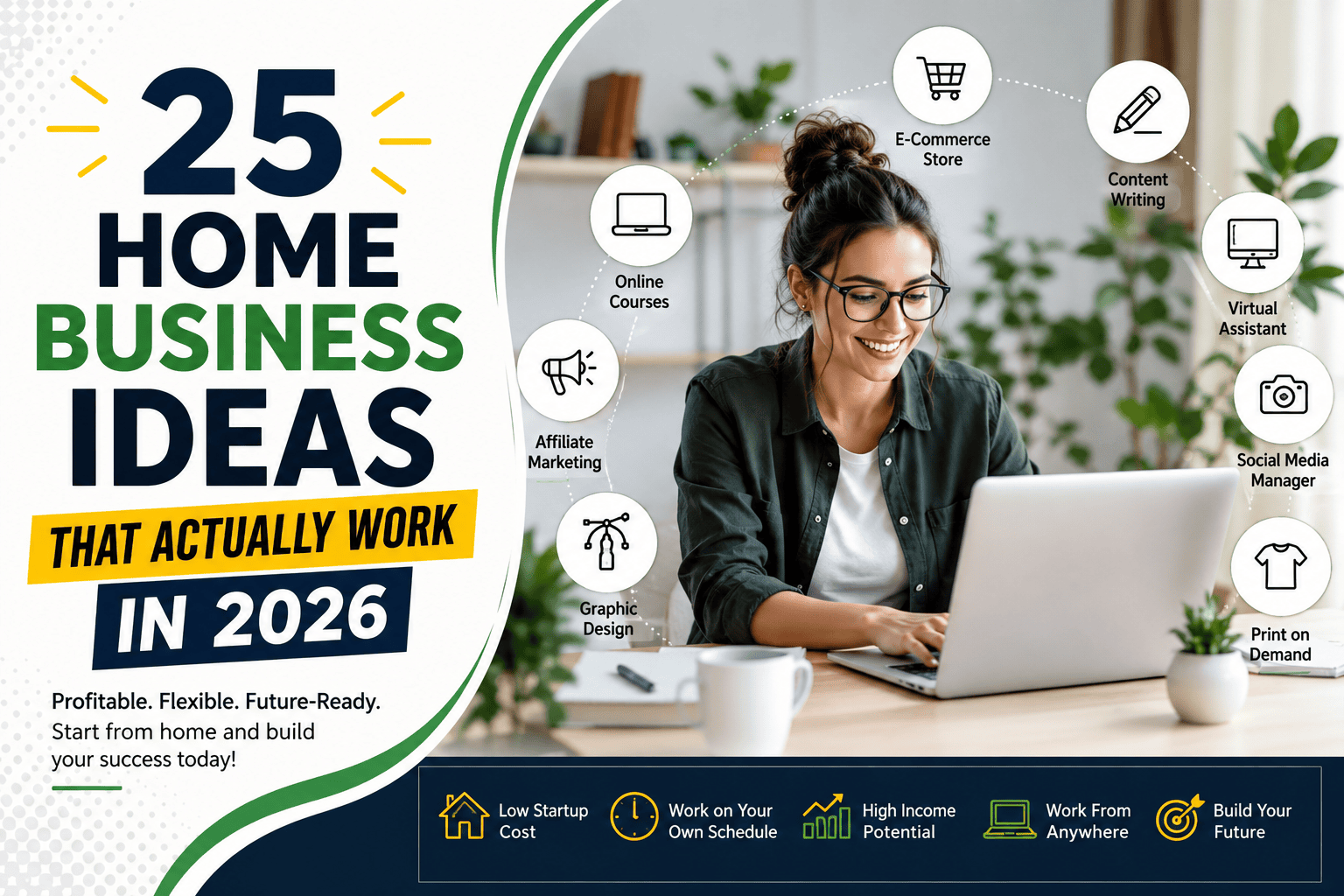
The best home business ideas in 2026 fall into four categories: service-based (freelancing, consulting, virtual assistance), product-based (e-commerce, handmade goods, print-on-demand), content-based (blogging, YouTube, courses), and skill-based (tutoring, coaching, bookkeeping). The right choice depends on your existing skills, available startup capital, and how much time you can commit weekly.
What Counts as a Home Business?
A home business is any income-generating venture you run primarily from your residence, using a home office, spare room, garage, or kitchen table as your base of operations. This differs from remote employment, where you’re still an employee of a company. A home business means you’re self-employed, own the business, and are responsible for your own taxes, marketing, and client relationships.
Home businesses can be full-time replacements for a job or part-time side income. Many start as side projects and grow from there.
Service-Based Home Business Ideas
Service businesses sell your time, skills, or expertise. They typically have the lowest startup costs since you don’t need inventory.
Freelance Writing or Editing
If you can write clearly, freelance writing is one of the most accessible home business ideas. Businesses need blog posts, website copy, email newsletters, and product descriptions. Editing and proofreading are related niches with steady demand from authors, students, and businesses.
Startup cost: Under $200 (laptop, portfolio site) Time to first client: 2–8 weeks typically
Virtual Assistant Services
Virtual assistants handle administrative tasks — email management, scheduling, data entry, customer service — for business owners who don’t want to hire in-house staff. This is a strong option if you’re organized and comfortable with common office software.
Bookkeeping
Small businesses consistently need help tracking expenses, invoices, and financial records. Basic bookkeeping doesn’t require a CPA license, though certification (such as through QuickBooks or the American Institute of Professional Bookkeepers) builds credibility.
Social Media Management
Many small businesses know they need a social media presence but don’t have time to manage it. If you understand platform algorithms and content trends, you can charge monthly retainers to plan, create, and post content for clients.
Web Design or Development
Businesses of every size need functional websites. Even basic skills with website builders like WordPress, Squarespace, or Webflow can turn into a service business, and coding skills (HTML, CSS, JavaScript) open up higher-paying custom work.
Product-Based Home Business Ideas
Product businesses involve making, sourcing, or reselling physical or digital goods.
Print-on-Demand Store
Print-on-demand lets you sell custom-designed products — t-shirts, mugs, phone cases — without holding inventory. A supplier prints and ships each order after a customer buys it. Your job is design and marketing.
Handmade Goods (Etsy or Craft Fairs)
If you make jewelry, candles, art, or other crafts, platforms like Etsy give you a built-in audience of buyers looking for handmade items. This works best when you have a genuine skill or hobby you can scale.
Dropshipping
Dropshipping means selling products online without stocking inventory yourself; a third-party supplier ships directly to your customer. It has low upfront costs but thinner profit margins and more competition than a decade ago, so success depends heavily on niche selection and marketing.
Digital Products
Digital products — templates, printables, stock photos, spreadsheets, or software tools — are created once and sold repeatedly with no shipping or inventory involved. This makes them one of the highest-margin home business ideas, though building an audience to sell to takes time.
Reselling (Thrift Flipping or Wholesale)
Buying discounted or secondhand items and reselling them at a markup, on platforms like eBay or Poshmark, is a low-barrier way to start earning without creating anything from scratch.
Content and Audience-Based Ideas
These businesses monetize an audience over time rather than a single transaction.
Blogging
A blog can generate income through ads, affiliate marketing, and sponsored content once it has consistent traffic. It’s slower to build than most people expect — usually 6–12 months of consistent publishing before meaningful income — but has long-term earning potential.
YouTube Channel
Video content monetizes through ad revenue, sponsorships, and affiliate links. Niches like education, product reviews, and how-to content tend to perform well for beginners because they attract search traffic, not just subscribers.
Online Courses or Coaching
If you have expertise in a specific area — fitness, career development, a technical skill — packaging that knowledge into a paid course or one-on-one coaching program can be highly profitable, especially once you already have some audience or credibility in that space.
Podcasting
Podcasts monetize more slowly than video or blogs, typically through sponsorships once you reach a consistent listener base, but they have lower production costs and can be recorded entirely from home.
Comparison Table: Home Business Ideas by Startup Cost and Time to Profit
| Business Idea | Startup Cost | Time to First Income | Skill Level Needed |
|---|---|---|---|
| Freelance Writing | Low ($0–200) | 2–8 weeks | Beginner–Intermediate |
| Virtual Assistant | Low ($0–200) | 2–6 weeks | Beginner |
| Bookkeeping | Low–Medium ($200–1,000) | 1–3 months | Intermediate |
| Print-on-Demand | Low ($0–100) | 1–3 months | Beginner |
| Handmade Goods | Medium ($100–1,000) | 1–4 months | Beginner–Intermediate |
| Dropshipping | Low–Medium ($100–500) | 1–3 months | Intermediate |
| Digital Products | Low ($0–200) | 2–6 months | Intermediate |
| Blogging | Low ($50–300/year hosting) | 6–12 months | Beginner–Intermediate |
| YouTube Channel | Low ($0–500) | 4–12 months | Intermediate |
| Online Courses | Medium ($200–1,000) | 2–6 months | Advanced |
Note: These figures are general estimates based on typical starting scenarios. Actual costs and timelines vary significantly based on niche, marketing effort, and existing audience.
How to Choose the Right Home Business Idea
Start With Your Existing Skills
The fastest path to income is usually a skill you already have. Someone with writing experience, an administrative background, or design skills can monetize that immediately rather than starting from zero in an unfamiliar field.
Consider Your Available Time
Service businesses like freelancing or virtual assistance can generate income within weeks but require ongoing hourly work. Content businesses like blogging or YouTube take longer to earn money but can eventually run with less day-to-day time investment.
Match Your Budget
If you have little startup capital, service-based and digital product businesses are the most accessible since they don’t require inventory. Product-based businesses involving physical goods usually need more upfront investment.
Common Mistakes to Avoid
- Choosing an idea based only on income potential, without factoring in whether you’ll actually enjoy or sustain the work.
- Underpricing services to win early clients, which makes it harder to raise rates later.
- Skipping basic business setup, like separating personal and business finances or understanding local tax obligations.
- Expecting fast results from content-based businesses, which typically take months to build momentum.
- Not validating demand before investing heavily in inventory or a niche product idea.
Best Practices for Starting a Home Business
- Validate the idea first. Talk to potential customers or clients before investing significant time or money.
- Start part-time if possible. Testing a business alongside existing income reduces financial risk.
- Set up basic systems early. A separate bank account and simple bookkeeping habit make tax season easier.
- Track your time and expenses, especially in the first few months, to understand what’s actually profitable.
- Reinvest early profits into tools, marketing, or skill development rather than treating all income as personal spending.
Key Takeaways
- Home business ideas generally fall into service, product, content, or skill-based categories.
- Service-based businesses like freelancing and virtual assistance have the lowest startup costs and fastest path to income.
- Product-based businesses require more upfront investment but can scale with less ongoing personal time.
- Content-based businesses take the longest to become profitable but offer strong long-term earning potential.
- The best choice depends on your existing skills, available time, and budget — not just what seems trendy.
Conclusion
There’s no single “best” home business idea — the right one depends on what you already know how to do, how much time you can realistically commit, and how much financial risk you’re comfortable taking on. Service-based options like freelancing or virtual assistance offer the fastest route to income, while product and content-based businesses take longer but can build into more scalable, long-term ventures. Whichever direction you choose, starting small, validating demand, and treating it like a real business from day one will put you in a stronger position than jumping in without a plan.
FAQs
What is the easiest home business to start with no money?
Freelance writing, virtual assistant work, and social media management require little to no upfront investment beyond a computer and internet connection, since you’re selling skills rather than products.
How much can you realistically make from a home business?
This varies widely by industry, effort, and experience. Many home businesses start as side income of a few hundred dollars a month before potentially growing into full-time income over one to two years.
Do I need a business license to run a home business?
Requirements vary by location and business type. Many freelancers and service providers operate as sole proprietors without a formal license, but it’s worth checking your local and state requirements, especially for product sales or regulated services.
What home business ideas make money fastest?
Service-based businesses like freelancing, virtual assistance, and consulting tend to generate income fastest, often within the first few weeks, since you’re paid directly for completed work.
Is dropshipping still profitable in 2026?
Dropshipping can still be profitable, but margins have narrowed due to increased competition. Success now depends more on niche selection, branding, and marketing than in earlier years.
Can I run a home business while working a full-time job?
Yes, many home businesses start as side projects. Service and content-based businesses are often easier to manage part-time since you control your own hours.
What’s the difference between a home business and remote work?
Remote work means you’re employed by a company but work from home. A home business means you’re self-employed and responsible for finding clients, managing income, and handling your own taxes.
How do I know if my home business idea will work?
Validate demand before investing heavily — talk to potential customers, research competitors, and consider starting with a small test offering before scaling up.