Food Storage in Plants: Where and How Plants Store Their Energy
Plants don’t have refrigerators or pantries, yet they manage to stockpile energy for months or even years at a time. Food storage in plants is the process by which plants convert the sugars made during photosynthesis into stable, storable forms — mainly starch — and hold them in specialized organs like roots, stems, seeds, and leaves until the energy is needed for growth, flowering, or survival through harsh seasons.
This isn’t a minor biological detail. It’s the reason carrots grow thick roots, potatoes form tubers underground, and onions build up fleshy layers. It’s also the reason we can eat rice, wheat, and beans at all — nearly every staple crop is, at its core, a plant’s food storage system that humans have learned to harvest.
Plants store food primarily as starch, along with smaller amounts of sugars, proteins, and oils, in organs such as roots, stems, tubers, bulbs, corms, seeds, and fruits. This stored energy fuels new growth, helps plants survive dormancy or drought, and supports reproduction when conditions improve.
Why Do Plants Need to Store Food?
Photosynthesis only happens when a plant has light, water, and carbon dioxide available at the same time. But plants face long stretches — winter, drought, or the period right after a seed germinates — when they can’t photosynthesize enough to meet their energy needs. Stored food acts as an energy reserve for exactly those gaps.
Three main situations drive the need for storage:
- Seasonal survival — perennial plants lose their leaves in winter and rely on underground reserves to resprout in spring.
- Reproduction — seeds need a packed energy supply to fuel germination before the young seedling can photosynthesize on its own.
- Regrowth after damage — grazing, fire, or cutting can strip a plant’s leaves, and stored reserves allow it to regenerate.
How Do Plants Convert Sugar Into Storable Food?
During photosynthesis, chlorophyll in leaf cells uses sunlight to combine carbon dioxide and water into glucose, a simple sugar. Glucose is useful for immediate energy, but it’s not efficient for long-term storage because it’s soluble and chemically reactive.
To solve this, plants link glucose molecules together into starch, an insoluble polysaccharide. Starch is compact, stable, and doesn’t interfere with a cell’s internal chemistry, making it the plant world’s preferred long-term energy reserve. When energy is needed again, enzymes break the starch back down into glucose, which is transported through the plant via a tissue called the phloem.
What Forms Does Stored Food Take?
| Storage Form | Description | Common Locations |
|---|---|---|
| Starch | Insoluble carbohydrate, the most common storage form | Roots, tubers, seeds, stems |
| Sugars | Soluble carbohydrates like sucrose | Fruits, sugarcane stems, sugar beet roots |
| Oils/Fats | Energy-dense storage, common in seeds | Sunflower, coconut, mustard seeds |
| Proteins | Used for both energy and building blocks for growth | Legume seeds (beans, peas, lentils) |
Where Do Plants Store Food?
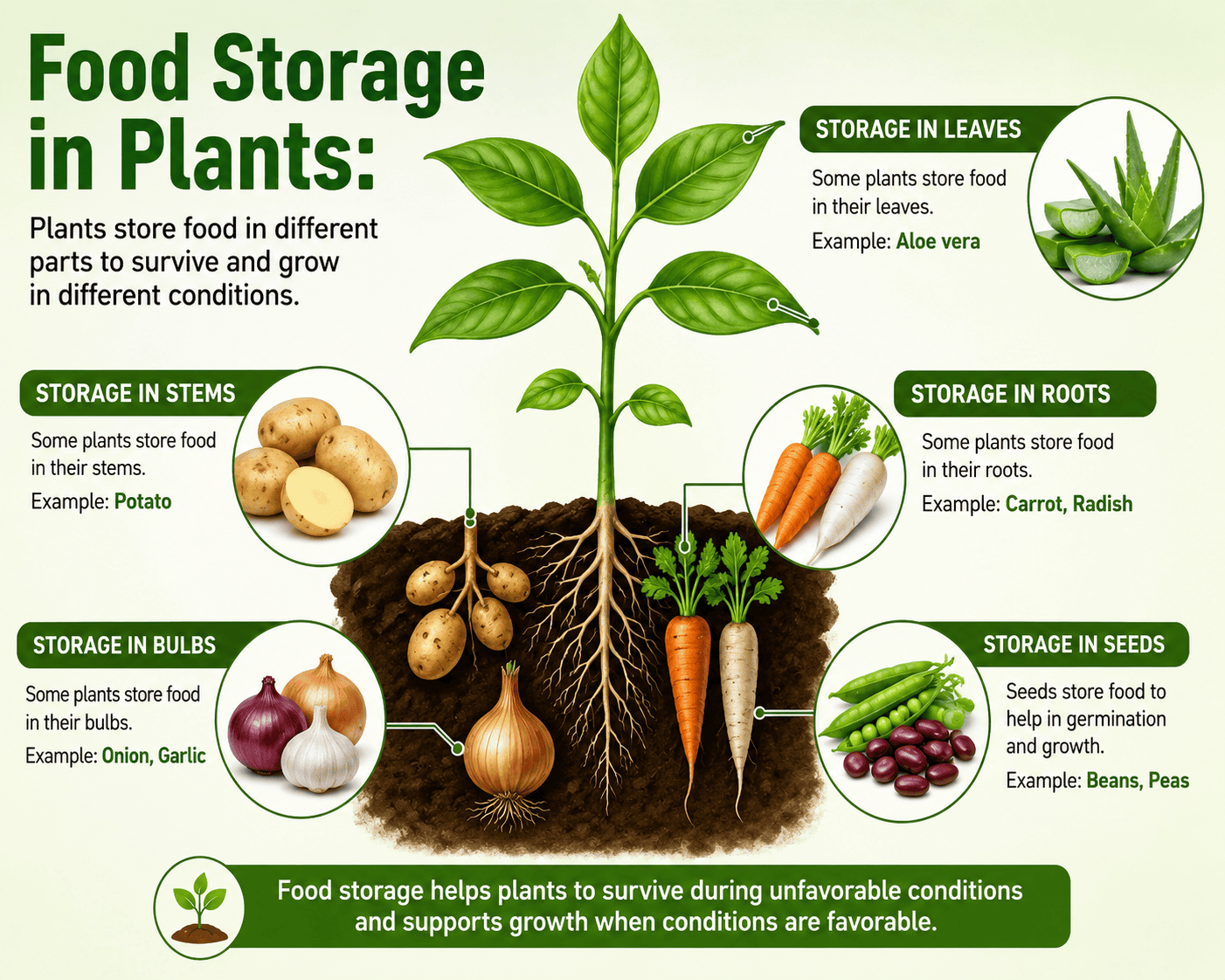
Different plants have evolved different storage strategies depending on their life cycle and environment. Below are the main storage sites.
Roots
Many plants thicken their roots into storage organs. Carrots, beets, sweet potatoes, and radishes are classic examples. These modified roots — sometimes called tuberous or taproot storage structures — swell with starch and sugars, particularly in the plant’s first growing season, to fuel flowering and seed production later.
Stems
Some plants store food in modified stems rather than roots.
- Tubers — Potatoes are underground stems (not roots) swollen with starch, with “eyes” that can sprout into new plants.
- Rhizomes — Horizontal underground stems, seen in ginger and turmeric, store food and also help the plant spread.
- Corms — Short, vertical underground stems, as in gladiolus and taro, packed with stored starch.
- Above-ground stems — Sugarcane stores large amounts of sucrose directly in its stem tissue.
Bulbs
Bulbs like onions, garlic, and tulips store food in fleshy, layered leaf bases surrounding a short central stem. Each layer is essentially a thickened leaf loaded with sugars and starch, protecting the plant’s bud through dormancy.
Leaves
Succulent plants such as aloe vera and cacti store water and some carbohydrates in thick, fleshy leaves, allowing survival in arid conditions. Cabbage also stores food in its tightly packed leaves.
Seeds
Seeds are perhaps the most concentrated food storage structures in the plant kingdom. Inside a seed, the endosperm or cotyledons hold a dense supply of starch, protein, and oil to power germination before the seedling can photosynthesize independently. This is why cereals (rich in starch), legumes (rich in protein), and oilseeds (rich in fat) each represent a different storage strategy.
Fruits
Fruits like bananas, mangoes, and grapes accumulate sugars as they ripen, which serves two purposes: providing energy reserves and attracting animals that help disperse the seeds inside.
Step-by-Step: How the Storage Process Works
- Photosynthesis produces glucose in the leaves using sunlight, water, and carbon dioxide.
- Conversion — glucose is converted into starch or sucrose for stable storage or transport.
- Translocation — the phloem tissue transports sugars from the leaves (“source”) to storage organs (“sink”) such as roots or seeds.
- Storage — starch accumulates in specialized cells (amyloplasts) within roots, stems, seeds, or other organs.
- Mobilization — when energy is needed, enzymes convert stored starch back into soluble sugars, which travel to wherever growth or repair is occurring.
Common Mistakes People Make About Plant Food Storage
- Confusing roots and stems — potatoes are frequently mislabeled as roots when they are actually modified stems (tubers).
- Assuming all stored food is starch — many seeds store mostly oil or protein, not starch.
- Thinking storage organs are only for human use — storage structures evolved for the plant’s own survival and reproduction, not for agriculture; humans simply learned to harvest them.
- Overlooking fruit as a storage site — fruit sugar isn’t just for taste; it plays a functional role in reproduction and seed dispersal.
Best Practices for Understanding (or Teaching) This Topic
- Compare storage organs side by side (root vs. stem vs. seed) rather than studying them in isolation — the differences become much clearer.
- Use real, cut-open examples (a potato, an onion, a bean seed) to visually confirm where the starch or fat is concentrated.
- Connect storage structures to the plant’s life cycle — dormancy, regrowth, and reproduction — rather than memorizing them as isolated facts.
Storage Organs Comparison Table
| Organ | Plant Origin | Example Plants | Main Storage Substance |
|---|---|---|---|
| Taproot | Root | Carrot, beet, radish | Starch, sugar |
| Tuber | Stem | Potato | Starch |
| Rhizome | Stem | Ginger, turmeric | Starch |
| Corm | Stem | Taro, gladiolus | Starch |
| Bulb | Leaf bases + stem | Onion, garlic | Sugar, starch |
| Leaf | Leaf | Cabbage, aloe vera | Starch, water |
| Seed | Seed (endosperm/cotyledon) | Wheat, beans, sunflower | Starch, protein, oil |
| Fruit | Fruit | Banana, grape | Sugar |
Key Takeaways
- Plants convert glucose from photosynthesis into starch, sugars, oils, or proteins for long-term storage.
- Common storage organs include roots, stems (tubers, rhizomes, corms), bulbs, leaves, seeds, and fruits.
- Storage supports survival through dormancy, fuels seed germination, and enables regrowth after damage.
- Many staple human foods — potatoes, rice, beans, onions — are essentially plant food-storage structures.
- Storage location depends on the plant species and its specific survival and reproductive strategy.
Frequently Asked Questions
1. What is the main form of food storage in plants? Starch is the primary storage form because it’s insoluble, stable, and doesn’t disrupt normal cell chemistry, unlike glucose.
2. Where do most plants store their food? It varies by species — common sites include roots, underground stems (tubers, rhizomes, corms), bulbs, seeds, and fruits.
3. Is a potato a root or a stem? A potato is a modified underground stem called a tuber, not a root, even though it grows below the soil.
4. Why do seeds store so much food? Seeds need enough reserve energy and nutrients to fuel germination and initial seedling growth before the plant can photosynthesize on its own.
5. Do all plants store food in the same way? No. Some rely on roots, others on stems, bulbs, or seeds, depending on their life cycle, climate, and reproductive strategy.
6. What’s the difference between starch storage and sugar storage? Starch is used for long-term, stable storage, while sugars like sucrose are more soluble and often used for shorter-term storage or transport, such as in sugarcane stems or ripening fruit.
7. Why do onions have layers? Each layer is a thickened, food-storing leaf base wrapped around the central bud, providing energy reserves during dormancy.
8. How does stored food help plants survive winter? Perennial plants draw on reserves in roots, bulbs, or stems to resprout leaves and resume growth once favorable conditions return in spring.
9. Can stored food in plants run out? Yes. If a plant’s stored reserves are depleted faster than they can be replenished through photosynthesis — from repeated damage, drought, or excessive shading — it can weaken or die.
10. Why do humans eat plant storage organs so often? Storage organs like tubers, seeds, and roots are naturally dense in carbohydrates, protein, or fat, making them efficient, nutrient-rich food sources for humans and animals alike.
Conclusion
Food storage in plants is a quiet but essential survival system. By converting sunlight into starch, sugars, oils, and proteins, and tucking that energy away in roots, stems, bulbs, seeds, and fruits, plants ensure they can weather dormancy, fuel new growth, and reproduce successfully. Understanding where and how this storage happens doesn’t just deepen appreciation for plant biology — it also explains why so much of human agriculture revolves around harvesting exactly these structures, from the potato in your kitchen to the wheat in your bread.
Why Home Improvement Is Important